
Fulton County Court Records After Arrest
A Fulton jail record and a Fulton court record are different records. The jail record reflects arrest-side booking, intake, custody, and sometimes charge or bond information available through jail channels. The court record is maintained by the clerk or court after a case opens. It shows what the prosecutor or court filed and what happened to the charges. Fulton County court records after a jail arrest may involve Magistrate Court first appearance, State Court misdemeanor proceedings, Superior Court felony proceedings, or a municipal court depending on the case type and agency.
The first custody check belongs on the Fulton County jail inmate records page when the question is whether someone is in jail or recently booked. Booking photos are a separate issue covered by Fulton County jail mugshots. The court-record search begins when the reader needs the formal case, charge status, accusation, indictment, disposition, bond hearing, or later record-restriction status. This split avoids a common mistake: treating a jail booking charge as the same thing as a filed court charge.
Search Fulton County Court Records After Arrest
Fulton Clerk resources are the main public route for court records after a jail arrest. The Fulton Clerk Find a Case page points users toward Magistrate, State, and Superior judicial records searches. The Tyler court portal is branded as Fulton County Magistrate, State, and Superior Court Record Search. During research, the public landing page showed Smart Search and Advanced Search Options, but sign-in and registration were required before search fields could be inspected.
- Start with the Fulton Clerk Find a Case page to choose the correct judicial-record route.
- Open the Fulton Tyler court portal and register or sign in when the portal requires it.
- Use Smart Search or Advanced Search Options to search by defendant name, case number, or other available fields after login.
- Open the case record and compare the filed charge list with any jail booking charge or bond note.
- Check each charge for current status, hearing history, disposition, sentence, or restriction language.
The Fulton Clerk case-search source shows the clerk's public routing point for judicial records.
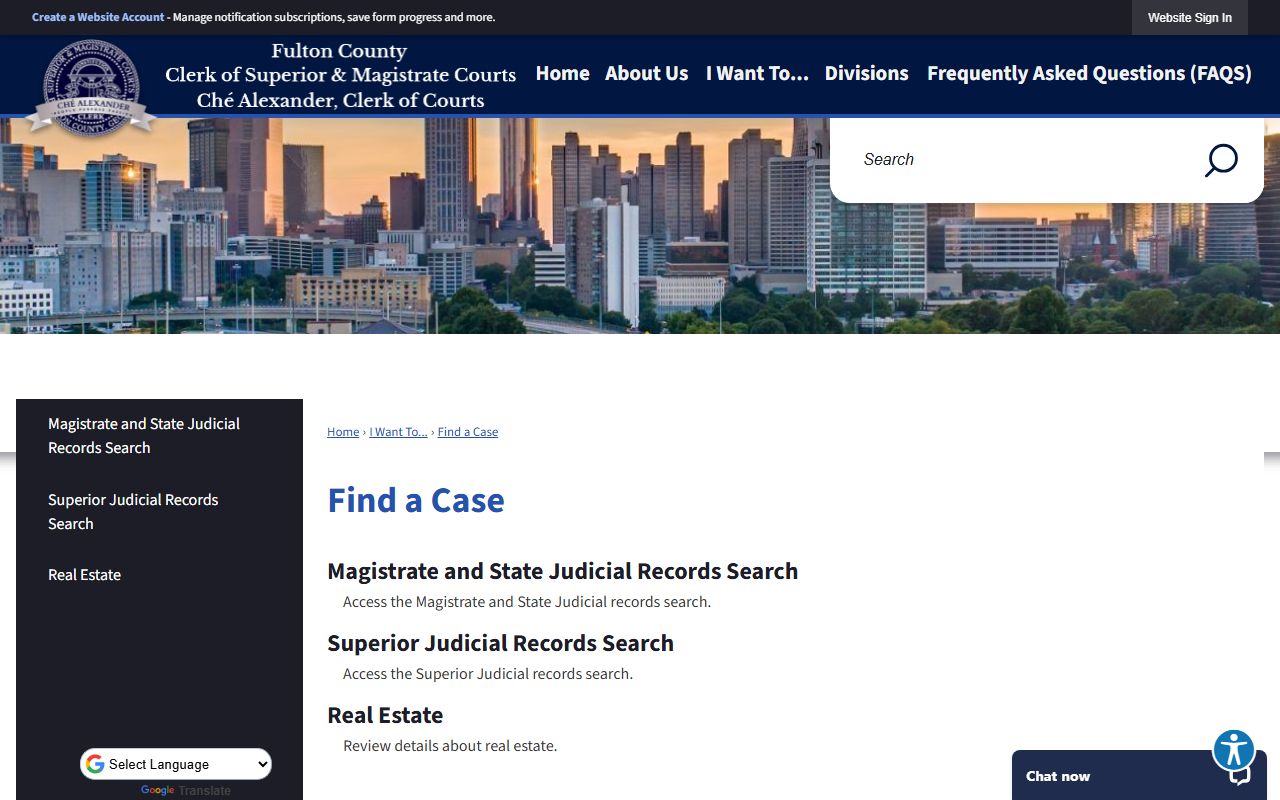
That routing point is useful because Fulton court records after an arrest may sit in different courts based on charge level and case path.
Fulton County Court Portal Limits
The Fulton Tyler court portal was visible at the landing-page level, but the search fields behind registration were not inspected. Do not assume public search fields such as date of birth, booking number, charge code, or party filters unless an account session confirms them. The confirmed access controls are narrower: the public page states that sign-in and/or registration is required, then points to Smart Search and Advanced Search Options.
| Field / Control | Type | Required | Notes |
|---|---|---|---|
| Register | Account control | Yes before search | Public landing says registration may be required. |
| Sign In | Account control | Yes before search | Needed to perform search in the portal. |
| Smart Search | Named search tool | After login | Public landing tells users to use Smart Search after access. |
| Advanced Search Options | Named control | After login | Used for additional filtering after access. |
| Make Payments | Payment link | No | Links to Fulton State Court traffic citation payment route. |
The Fulton court portal source shows the sign-in and registration notice for court records after a jail arrest.
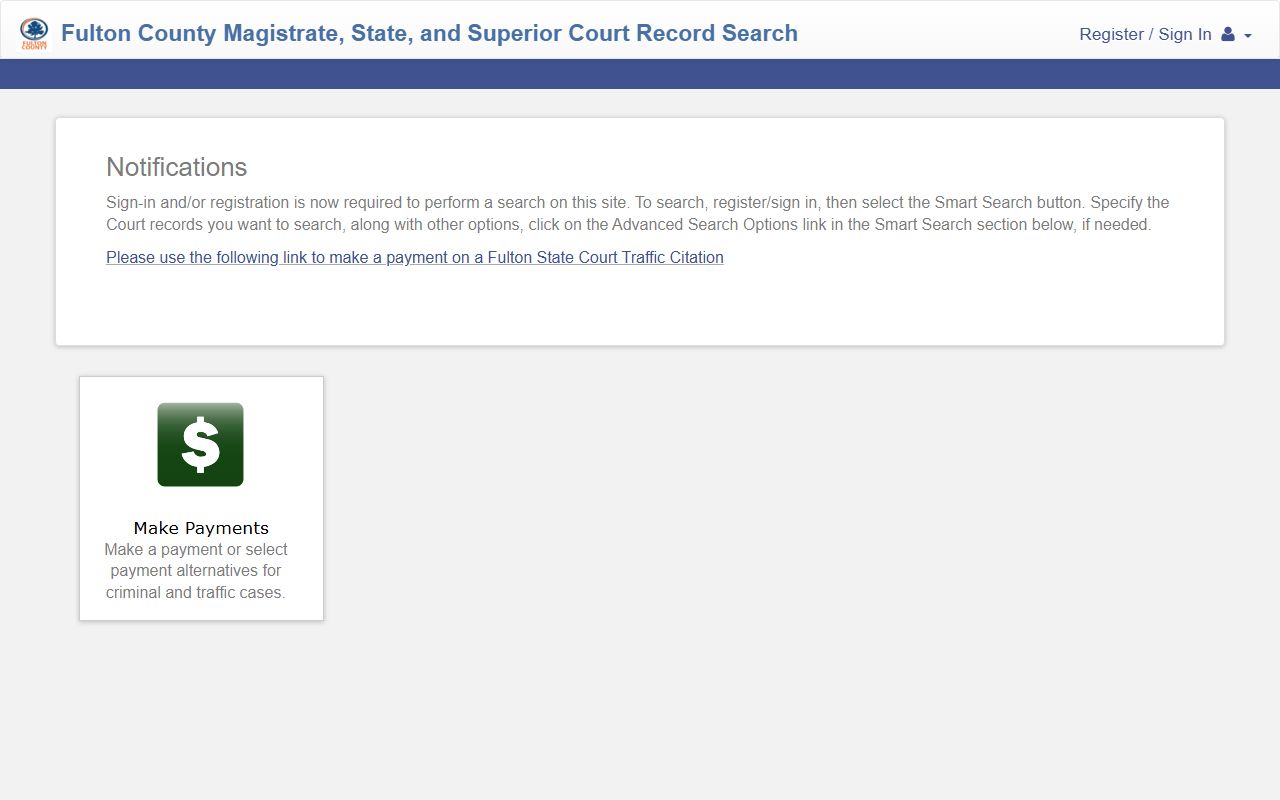
The login requirement is why phone, clerk, and open-records channels remain important when the case cannot be found online.
Charging Documents After Arrest
After arrest and jail booking, the charge record becomes a court record through charging documents and court entries. Fulton Clerk materials say the clerk prepares papers of accusations, indictments, and dispositions for Superior Court criminal actions. Felony cases proceed through prosecutor review and Superior Court processes. Misdemeanor matters may route through State Court or another division. The charging document matters because it can change the charge list that appeared during booking.
| Document | Who Uses It | What It Does |
|---|---|---|
| Complaint | Officer, prosecutor, or court process | Starts or supports a criminal matter based on alleged facts and probable cause. |
| Accusation / Information | Prosecutor | Formal prosecutor-filed charge document, often used for non-indicted matters. |
| Indictment | Grand jury and prosecutor | Formal felony charging document after grand-jury action. |
These labels should be read with the docket. A complaint can exist early, while an accusation, information, or indictment may reflect later prosecutor review. Fulton County court records after a jail arrest may show one charge at booking and a different charge after filing.
Fulton County Charge Status
Charge status is the reason court records after an arrest are more useful than a booking entry alone. A booking charge is an initial custody record. Court charges may be added, dismissed, amended, reduced, indicted, accused, sentenced, or disposed. Fulton District Attorney felony review and clerk case records are key sources for the formal status. For a new arrest, bond or first-appearance information may post before full case activity appears in the court portal.
| Status | Plain Meaning |
|---|---|
| Pending | The charge remains open and has not reached final disposition. |
| Amended | The charge wording, code, level, or count changed after filing. |
| Reduced | The charge was lowered to a lesser offense or level. |
| Dismissed | The charge was ended by court order or prosecution action. |
| Nolle prosequi | The prosecutor chose not to pursue the charge. |
| Convicted / Sentenced | The charge resulted in a plea, verdict, and sentence. |
| Disposed | The court case or charge has reached an outcome. |
Bond Hearings After Fulton Arrest
Bond is part of the arrest-to-court pathway. Fulton County says arrestees who do not bond out routinely appear before a judge within 24 hours after arrest, while weekend arrests appear Monday. The judge advises the arrestee of charges and may address bond. The jail page also says Booking receives first-appearance results around 4:00 p.m. each day from the Clerk of Courts, so callers looking for bond on a new arrest may need to wait until those results arrive.
| Bond Type | How It Works in Fulton Context |
|---|---|
| Cash bond | Paid with accepted cash-bond methods; refunds are handled later through the courthouse with final disposition and receipt. |
| Surety bond | Posted through a licensed bonding company under Georgia commercial bail practice. |
| Property bond | Questions route through the Fulton Sheriff Bond Administration Unit. |
| Recognizance / ROR | Release without cash payment, sometimes after screening or with conditions. |
| Supervised ROR | Release with screening and supervision; Fulton says this process may take longer. |
| No-bond hold | Custody continues until the court or holding agency permits release. |
Warrants Before Court Records
A warrant can be the event that leads to the jail arrest, but Fulton did not have a confirmed general public warrant-search database in official sources reviewed. The sheriff's Most Wanted page is a selected fugitive list, not a full active-warrant index. Georgia.gov tells users to contact the local sheriff's office for information about an existing warrant in that county. Fulton Magistrate criminal matters include warrant applications, first appearances, preliminary hearings, and child-abandonment warrant applications.
When a person is arrested on a warrant, the custody path still runs through booking and first appearance. Fulton intake includes a warrants check. Court records may later show warrant-related entries once they are part of a public case file. If the issue is safety or a listed wanted person, the sheriff warns the public not to approach and to call 911.
Charges vs Convictions
An arrest, a charge, and a conviction are not the same thing. Fulton County court records after a jail arrest can show charges long before a final court outcome. A charge is an accusation being processed by the court. A conviction requires a plea, verdict, or other final finding. That distinction matters for employment, housing, licensing, public reporting, and any attempt to understand a person's case history.
| Point | Charge | Conviction |
|---|---|---|
| Stage | Accusation after arrest or filing. | Final result by plea, verdict, or qualifying disposition. |
| Proof | Based on probable cause and prosecutor/court process. | Based on guilty plea, trial verdict, or accepted legal outcome. |
| Can change? | Yes. It may be amended, reduced, added, or dismissed. | Changes only through appeal, correction, set-aside, pardon, or other legal process. |
| Record use | Shows what was alleged or filed. | Shows what was proven or admitted. |
Restricted and Sealed Records
Georgia commonly uses the term record restriction rather than expungement. The GBI record-restriction guidance explains that restriction limits public and private dissemination of eligible criminal history, while criminal-justice agencies may still retain access. Georgia.gov also provides a route to request record restriction or expungement information for eligible cases. Fulton County court records after an arrest may therefore be public, partly restricted, sealed by court order, or withheld because of law-enforcement, prosecution, juvenile, or court-order limits.
| Term | Public Visibility | Georgia Context |
|---|---|---|
| Restricted | Limited from public or private dissemination. | Georgia criminal-history restriction under O.C.G.A. 35-3-37 may apply to eligible outcomes. |
| Sealed | Hidden from ordinary public access by law or court order. | May apply to juvenile, sensitive, or court-protected records. |
| Expunged | Often used by the public to mean cleared. | Georgia materials often route this concept through record restriction rather than destruction. |
Fulton Court Records Requests
Some court records after a jail arrest require clerk or open-records channels instead of the online portal. Fulton Clerk of Superior and Magistrate Courts is located at the Lewis R. Slaton Courthouse, 136 Pryor Street, Room 106, Atlanta, GA 30303. The public records information reviewed lists the criminal records request phone as 404-613-5313 and the Criminal Division as 404-612-5174. Prosecutor records route through the Fulton County Open Records Center, though law-enforcement and prosecution exemptions may apply while a case is pending.
The Fulton County District Attorney's Office prosecutes felony cases in Fulton County and the Atlanta Judicial Circuit. The current DA is Fani T. Willis. Fulton lists the DA office at 136 Pryor St SW, 3rd Floor, Atlanta, GA 30303, with phone 404-612-4981. DA open-records requests may be submitted through the county Open Records Center. State criminal-history reports are separate from court dockets and may require GBI procedures, fingerprints, consent, or fees.
Important: Court records after an arrest should not be used for FCRA-covered screening unless obtained through a lawful consumer-reporting process.